
cab ISO 639
Garífuna Autonyms
Garifuna
Visualizations
Language Cloud
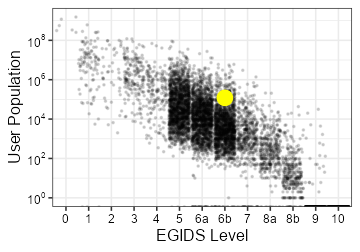
Details
A language of Honduras
- Primary Name
- Garifuna
- ISO 639
- cab
- Alternate Names
- Black Carib, Caribe, Central American Carib, Garínagu, Karif
- Autonym
- Garífuna
- Population
- 43,100 in Honduras (2013 census), based on ethnicity. 100 monolinguals. Ethnic population: 100,000 (2021 J. Leclerc). Total users in all countries: 119,400.
- Location
- Atlántida and Colón departments; Cortes department: north coast between Masca and Plaplaya in Gracias a Dios department; Islas de la Bahía (Roatan island) department; cities: La Ceiba, Puerto Cortés, San Pedro Sula, and Tegucigalpa; 37 villages.
- Language Maps
- Belize, El Salvador and Honduras, Guatemala
- Language Status
- 6b (Threatened).
- Classification
- Maipurean, Northern, Maritime, Ta-Maipurean, Iñeri
- Dialects
- Western Garifuna, Eastern Garifuna. Related to Island Carib [crb], with borrowings from Carib [car], Spanish [spa], English [eng], and French [fra]. Eastern Garifuna dialect is spoken in Honduras (leaves out, r, and tends to shorten words), Western Garifuna in Guatemala and Belize.
- Typology
- VSO.
- Language Use
- All domains. Some of all ages. Positive attitudes. A few also use English [eng]. Also use Spanish [spa], with some shifting in some villages.
- Language Development
- Literacy rate in L1: 1%–5%. Literacy rate in L2: 5%–15%. Radio. Dictionary. Grammar. Texts. Bible: 2002.
- Digital Support
- Ascending (0.21).
- Writing
- Latin script [Latn].
- Other Comments
- Ancestors taken from Saint Vincent Island in 1796–1797, and taken to Roatan Island. Most went to Trujillo, Honduras in 1937. About 35 years later political troubles threatened their existence, and they fled further east into Honduras and Belize. Later they emigrated to other countries. Christian, traditional religion.
- Language Resources
- OLAC resources in and about Garifuna
Also Indigenous in
- Primary Name
- Garifuna
- ISO 639
- cab
- Alternate Names
- Caribe, Central American Carib, Garínagu, “Black Carib” (pej.), “Moreno” (pej.)
- Population
- 8,440 in Belize (2014 UNSD). Ethnic population: 15,100 (2013 census).
- Location
- Belize, Stann Creek, and Toledo districts: 6 villages.
- Language Maps
- Belize, El Salvador and Honduras, Guatemala
- Language Status
- 6b (Threatened).
- Classification
- Maipurean, Northern, Maritime, Ta-Maipurean, Iñeri
- Dialects
- Western Garifuna.
- Typology
- VSO.
- Language Use
- Some young people, all adults, few children (2013 census). Also use Belize English Creole [bzj]. Also use English [eng].
- Other Comments
- Ancestors taken from Saint Vincent Island in 1796–1797, and taken to Roatan Island. Most went to Trujillo, Honduras in 1937. About 35 years later political troubles threatened their existence, and they fled further east into Honduras and Belize. Later they emigrated to other countries.
- Language Resources
- OLAC resources in and about Garifuna
- Primary Name
- Garifuna
- ISO 639
- cab
- Alternate Names
- Black Carib, Caribe, Central American Carib, Garífuna, Garínagu
- Population
- 2,860 in Guatemala (2019 census). Ethnic population: 19,500 (2019 census).
- Location
- Izabal department: Livingston and Puerto Barrios villages; northeast coast.
- Language Maps
- Belize, El Salvador and Honduras, Guatemala
- Language Status
- 6b (Threatened). Recognized language (2003, Law of National Languages, Decree 19).
- Classification
- Maipurean, Northern, Maritime, Ta-Maipurean, Iñeri
- Dialects
- Western Garifuna.
- Typology
- VSO.
- Language Use
- Some young people, all adults. All also use Spanish [spa].
- Language Development
- Literacy rate in L1: 1%–5%. Literacy rate in L2: 15%–20%.
- Other Comments
- Ancestors taken from Saint Vincent Island in 1796–1797, and taken to Roatan Island. Most went to Trujillo, Honduras in 1937. About 35 years later political troubles threatened their existence, and they fled further east into Honduras and Belize. Later they emigrated to other countries.
- Language Resources
- OLAC resources in and about Garifuna
Also Spoken in
- Location
- South Caribbean Coast Autonomous Region: Orinoco village.
- Alternate Names
- Black Carib, Caribe, Central American Carib, Garífuna, “Moreno” (pej.)
- Language Status
- 9 (Dormant). Recognized language (1993, Official Language Use, Atlantic Autonomous Regions, Law No. 162, Article 4).
- Language Use
- Shifted to Spanish [spa].
- Other Comments
- Non-indigenous. Ancestors taken from Saint Vincent Island in 1796–1797, and taken to Roatan Island. Most went to Trujillo, Honduras in 1937. About 35 years later political troubles threatened their existence, and they fled further east into Honduras and Belize. Later they emigrated to other countries. View other languages of Nicaragua
Primary Name
Garifuna
User Population
No known L1 speakers in Nicaragua (2012 R. Reeck). Ethnic population: 3,270 (2005 census).
- Location
- California: Los Angeles; Florida: Miami; Louisiana: New Orleans; New York: New York City.
- Language Status
- Unestablished.
- Other Comments
- Non-indigenous. View other languages of United States
Primary Name
Garifuna
User Population
65,000 in United States (2001 E. Velásquez).