
What is the Digital Language Divide?
The Digital Language Divide
In the era of the Internet and global communications, immeasurable amounts of digital information are being created, shared, and consumed. For billions of people, this means instant access to health information, education, career opportunities, news, social interaction, entertainment, communication tools, and digital content of every conceivable kind.
Although many people can access such information in their first language (their ‘mother tongue’), digital equality does not exist across all of the world’s living languages. As of 2023, 54% of the world’s population had limited or no access to digital language technologies (Derivation, 2023)
From a technological perspective, digital language capabilities are illustrated using the 6-point global Digital Language Scale (DLS). It’s a critical area of focus for academics, companies, and perhaps most of all, the billions of people it impacts.
- The strongest digital languages are classified as Supported, broadly signifying a language is thriving digitally. This includes advanced features such as voice recognition, artificial intelligence, machine translation, and voice assistants.
- In the middle are languages with Partial Support, which might feature some form of digital encoding (e.g. fonts and keyboards), spell-checking, and a variety of content in digital forms.
- The weakest digital languages are classified as Unsupported, broadly signifying there is no hardware, no software, and no digital presence of any kind.
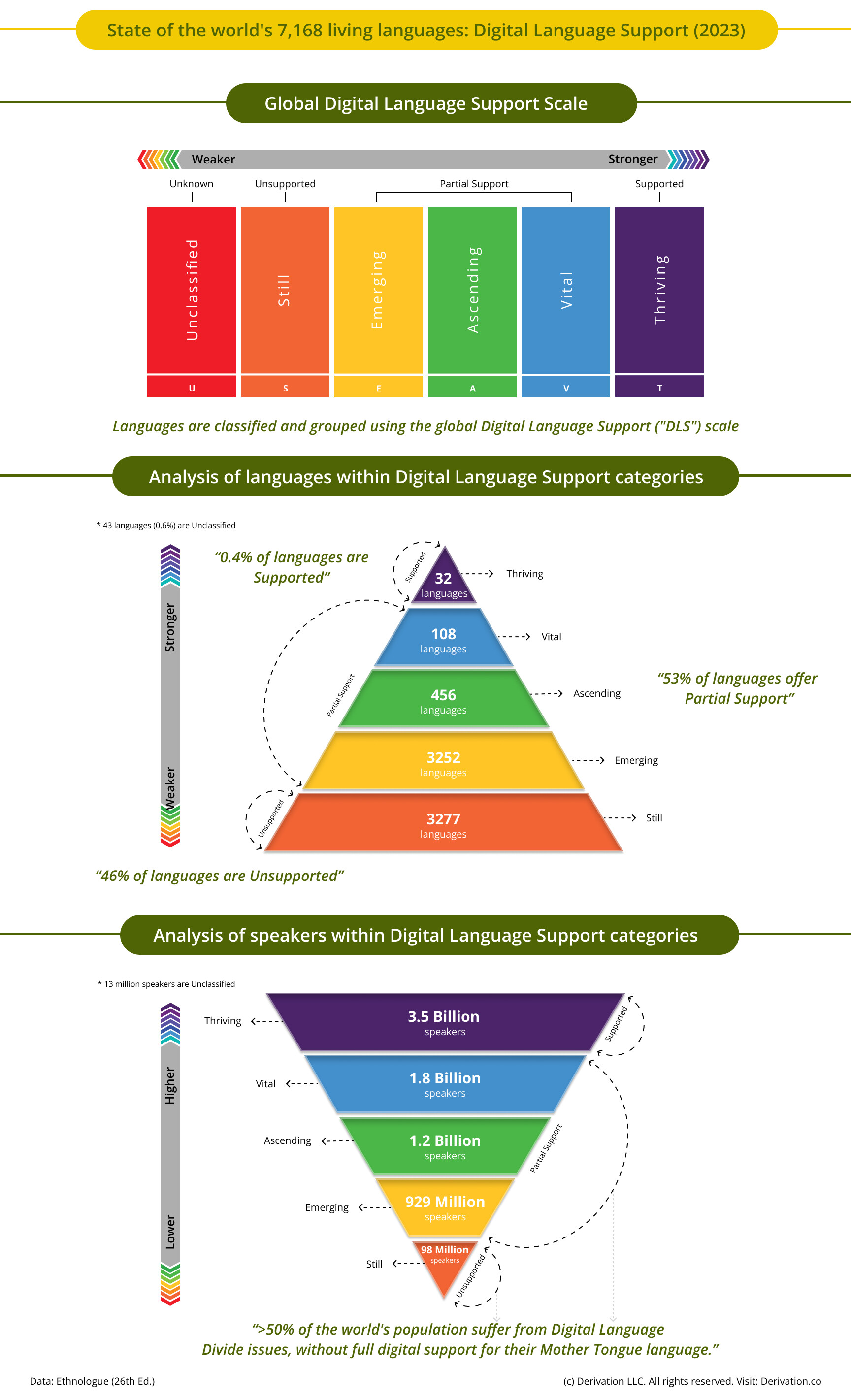
The gap between those languages with full digital support (Supported) and those without it (Partial Support + Unsupported) is often referred to as the Digital Language Divide. Speakers, readers, and signers of these non-digital languages lack access to information, communication, products, and services in their native languages. As a result, they’re often left with a difficult choice: either struggle to navigate content in a language they may not fully understand, or be excluded from accessing vital digital language content altogether. Unsurprisingly, many of these ‘digitally weaker’ languages are also endangered, and without digital capabilities, they face an even greater risk of extinction.
Want to explore DLS further?
- Discover real-life data application with our Digital Language Support Intelligence Tool
- Dive into the research in the paper Assessing Digital Language Support on a Global Scale

About Ethnologue Ethnologue is the research center for language intelligence. We help you identify languages, find where they’re used, get population estimates, and more. See Features »