
How do we classify and measure the status of languages?
EGIDS is the primary tool used by Ethnologue to indicate a language's status.
There are vast differences in the number of speakers, writers, and signers of the world’s 7000+ languages, ranging from those with more than a billion worldwide down to those with a handful of isolated, elderly users of dying indigenous languages. In similar fashion to the natural kingdom, where plant and animal species range from abundant to endangered, languages are also classified as stronger or weaker using different scales. One important dimension is language status, classified using the 13-point Expanded Graded Intergenerational Disruption Scale (EGIDS). The EGIDS scale can be broken down into five main categories:
- Institutional: At the top of the scale are stronger languages. Their classification broadly signifies official usage within government, trade, and education.
- Stable: In the middle of the scale are languages with widespread social use within communities across all age ranges.
- Endangered: This classification of weaker languages signifies different degrees of vulnerability, represented by two subgroups:
- In Trouble: Languages where the natural "Parent teaching Child" process is weakening.
- Dying: Languages where native speakers are elderly without fluency existing in younger generations.
- Extinct: These are languages that have ceased to exist within the last 200 years or so.
- Unclassified: This final category represents the small group of languages without a current EGIDS classification.
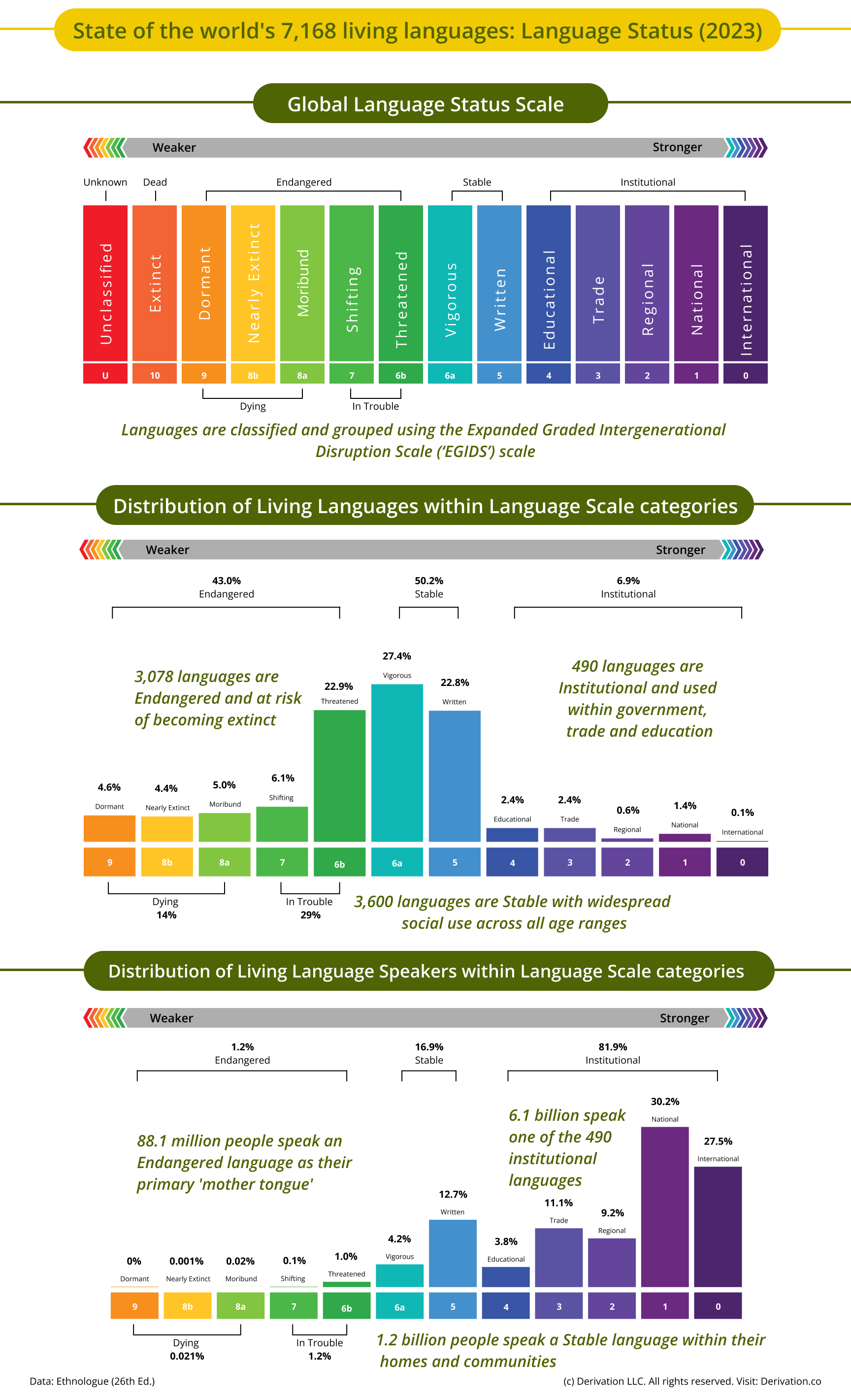
As our analysis illustrates, 6.1 billion people speak one of the 490 Institutional languages used in government, trade, and education; whereas speakers of 3,078 Endangered languages account for 88.1 million individuals (26th edition, 2023). Our infographic is designed to educate and inform people about the scale of potential language loss, and advocate for urgent action to protect and preserve endangered indigenous languages. It is a prior winner of the coveted Editor’s Choice award from Visual Capitalist.

About Ethnologue Ethnologue is the research center for language intelligence. We help you identify languages, find where they’re used, get population estimates, and more. See Features »